Call for Papers
Undangan menulis untuk para dosen, guru, mahasiswa dan praktisi pendidikan

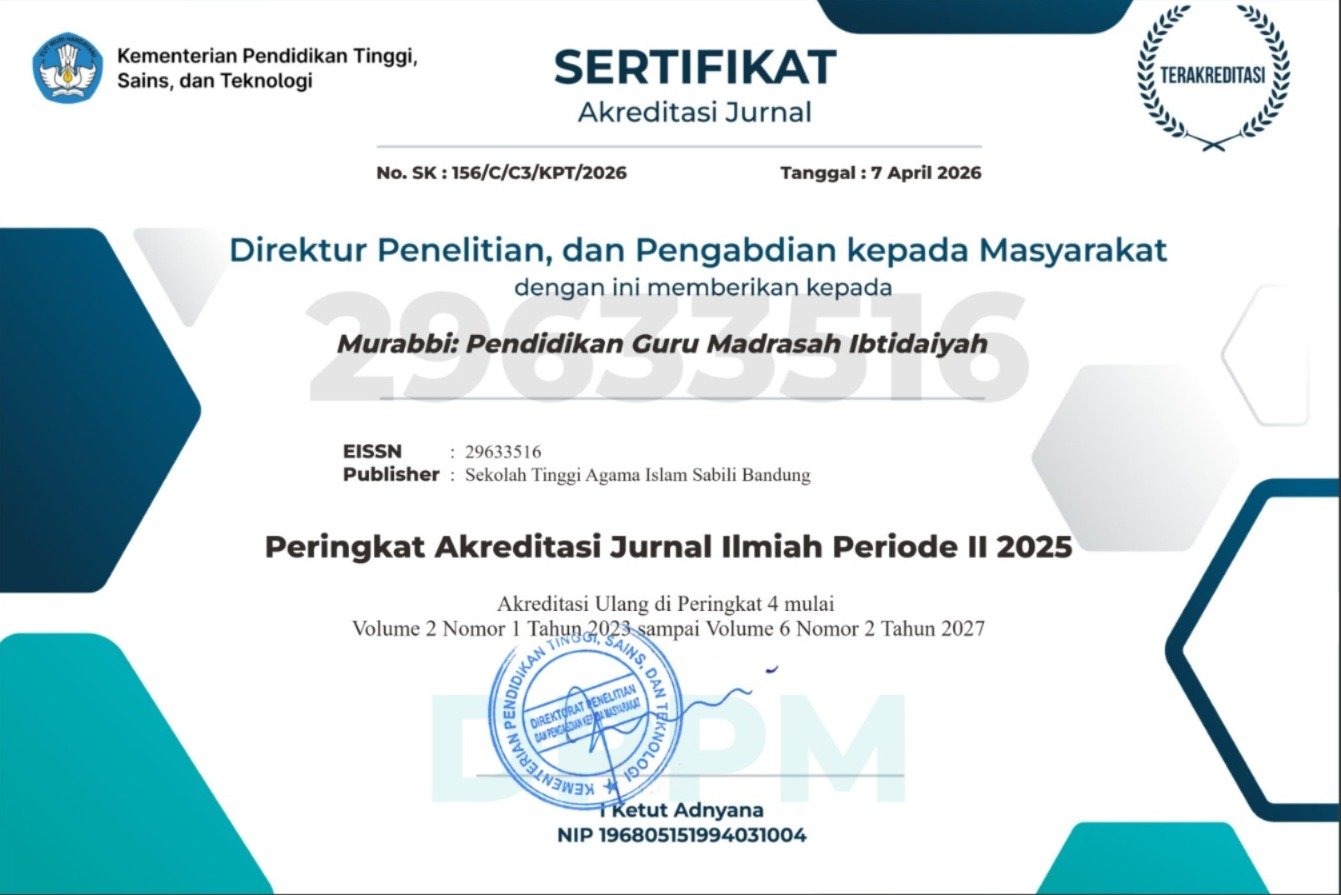
Based on the Decree of the Director General of Research and Development of the Ministry of Higher Education, Science and Technology number 156/C/C3/KPT/2026, Murabbi Journal since 2026 has been indexed by the Scientific Journal Accreditation Rank 4 (Sinta 4)
Murabbi: Pendidikan Guru Madrasah Ibtidaiyah is an open access journal, and peer-reviewed journal to discuss about new findings in elementary education especially at primary/elementary schools. This journal is publishing original research articles and case studies focused on elementary education. All papers are peer-reviewed by at least two reviewers.
Murabbi : Pendidikan Guru Madarasah Ibtidaiyah, E-ISSN 2963-3516 is a peer-reviewed scientific media that focuses on disseminating research results in the field of elementary education. This journal is published by the Study Program of Pendidikan Guru Madarasah Ibtidaiyah (PGMI) at STAI Sabili Bandung. Publication schedule is in June and December.
Pembelajaran IPAS pada SD Negeri 1 Sepang Kelod masih mengalami beberapa permasalahan dan kendala akibat beberapa faktor, khususnya pada materi Harmoni dalam Ekosistem. Tujuan studi ini untuk mengetahui perbaikan hasil pembelajaran IPAS tentang Harmoni dalam Ekosistem dengan pengimplementasian model Problem Based Learning (PBL) yang diorientasikan dengan Tri Hita Karana. Metode tindakan kelas yang dirancang dua siklus digunakan pada studi ini dengan meliputi tahap perencanaan, pelaksanaan, pengamatan, hingga refleksi. Metode observasi, tes hasil belajar dan dokumentasi dipergunakan dalam proses pengumpulan data hasil belajar siswa. Subjek pada studi tindakan kelas ini meliputi 15 orang siswa kelas V di SD Negeri 1 Sepang Kelod. Instrumen studi ini terdiri atas lembar observasi, tes pilihan ganda sejumlah 10 item soal. Analisis data dilaksanakan melalui pendekatan mix method. Temuan studi tindakan kelas merepresentasikan bahwa terjadi peningkatan hasil belajar IPAS siswa selama siklus I dan II yang ditandai dengan mean siklus I yaitu 71,67 dengan daya serap 71,67%. Kemudian, mean siklus II mengalami peningkatan hingga memperoleh mean sebesar 82,33 dan daya serap sebesar 82,33%. Ketuntasan klasikal siswa pada siklus I yaitu 60% (kategori cukup) mengalami peningkatan hingga mencapai 100% (kategori Sangat Baik). Hal ini menyimpulkan bahwasannya penerapan model PBL berorientasi Tri Hita Karana berhasil memperbaiki dan meningkatkan pembelajaran IPAS siswa kelas V SD.
Riset ini bertujuan untuk menganalisis penggunaan media gambar dalam meningkatkan kemampuan bercerita pada mata pelajaran Bahasa Indonesia siswa kelas V SD Negeri 1 Luaor. Latar belakang penelitian berangkat dari rendahnya kemampuan bercerita siswa, yang terlihat dari kurangnya kemampuan mengembangkan ide, menyusun alur cerita, serta keterbatasan kosakata yang digunakan saat berbicara. Penelitian ini menggunakan pendekatan kualitatif dengan mengkaji permasalahan secara mendalam. Data dikumpulkan melalui observasi kegiatan pembelajaran, wawancara dengan guru dan siswa, serta dokumentasi hasil pekerjaan siswa. Analisis data dilakukan melalui tahapan reduksi, penyajian data, dan penarikan kesimpulan, serta divalidasi dengan triangulasi untuk memastikan keabsahan temuan. Hasil penelitian menunjukkan bahwa media gambar memiliki peran penting dalam menstimulasi imajinasi dan membantu siswa mengorganisasikan ide menjadi cerita yang runtut dan menarik. Penggunaan media gambar juga meningkatkan partisipasi aktif siswa selama pembelajaran dan mendorong keberanian mereka dalam menyampaikan pendapat. Faktor pendukung utama meliputi kesesuaian media dengan pengalaman siswa serta strategi guru dalam memberikan arahan melalui diskusi kelompok. Adapun hambatan yang ditemui antara lain keterbatasan waktu dan perbedaan kemampuan antar siswa. Dengan demikian, dapat disimpulkan bahwa penerapan media gambar secara tepat dapat menjadi strategi yang efektif untuk meningkatkan kemampuan bercerita siswa sekolah dasar, khususnya dalam pembelajaran Bahasa Indonesia di kelas V SD Negeri 1 Luaor.
Basic literacy skills are the main foundation in the learning process in elementary school. However, there are still high class students who do not know the letters of the alphabet. This study aims to describe teachers' strategies in learning basic literacy for grade IV students at UPT SD Negeri 169 Sadar who experience literacy delays. This study uses a descriptive qualitative approach. Data was collected through observation, interviews, and documentation, then analyzed by data reduction techniques, data presentation, and conclusion drawn. The results showed that teachers used three main strategies, namely: (1) phonics learning to introduce the relationship between letters and sounds, (2) the use of concrete media such as letter cards, pictures, and real objects, and (3) an individual and collaborative approach with parents. This strategy helps students recognize letters, read simple words, and increase learning motivation. This research emphasizes the importance of teacher innovation in adapting learning to the needs of students who experience delays in basic literacy.
This study aims to analyze the application of the Deep Learning approach in mathematics learning in the lower class at MI Muslim Scholars Center. The Deep Learning approach is used to foster students' conceptual understanding, critical thinking, and reflective abilities towards basic math material. The research method used is a descriptive qualitative approach with data collection techniques through observation, interviews, and documentation. The research subjects consisted of teachers and students in grade I of the Muslim Scholars Center. The results of the study show that the application of the Deep Learning approach can increase student learning activity and motivation through student-centered learning activities, such as group discussions, exploration of contextual problems, and reflection on learning outcomes. Students show improved ability to understand number concepts, basic calculation operations, and the application of concepts in daily life. In addition, teachers play an important role as facilitators in directing the deep thinking process and ensuring the active involvement of each student. Thus, the application of the Deep Learning approach has proven to be effective in improving the quality of mathematics learning in low grades, and can be used as an innovative alternative in an effort to improve numeracy competence in madrasah-based elementary schools.
Scientific reasoning is a fundamental competence required for preservice primary teachers, particularly those who will teach science at the elementary level. Despite its importance, empirical evidence regarding the scientific reasoning profile of prospective Madrasah Ibtidaiyah (MI) teachers remains limited. This study aimed to profile the scientific reasoning skills of pre-service MI teachers enrolled in a Basic Natural Science course. A descriptive quantitative design was employed involving 35 students from a Primary Teacher Education Program. The instrument consisted of 20 items developed based on Lawson’s six dimensions of scientific reasoning: conservation, proportional reasoning, control of variables, probabilistic reasoning, correlational reasoning, and hypothetico-deductive reasoning. Data were analyzed using descriptive statistics, including mean, standard deviation, and distribution across reasoning levels. The results indicated that the overall mean score was 73.68, suggesting a moderate-to-high level of scientific reasoning. The highest performance was observed in hypothetico-deductive reasoning, whereas probabilistic and correlational reasoning yielded the lowest scores. In terms of reasoning levels, 54.29% of students were categorized at the formal reasoning level, 37.14% at the transitional level, and 8.57% at the concrete level. Although the majority of students demonstrated formal reasoning ability, substantial variability across dimensions suggests the need for instructional approaches that explicitly strengthen multivariable and probabilistic reasoning. These findings provide an empirical basis for designing inquiry-oriented instruction in Basic Natural Science courses to better prepare pre-service teachers for science teaching in primary education.
MAPP ADRESS: